Hello, My Name is Hani W. Naguib
I Have Been Working With Aspiring Entrepreneurs
& Innovative Companies Since 2012

I Have Been Working With Aspiring Entrepreneurs
& Innovative Companies Since 2012

Most teams treat personas as static artifacts: age, gender, job title, pain points, and a smiling stock photo. These personas are frozen in time, disconnected from reality, and quickly become irrelevant.
In real life, people do not behave consistently across contexts. The same person makes different decisions depending on where they are, what they are trying to achieve, what constraints they face, and what alternatives are available at that moment. Context shapes behavior more than personality.
This is why personas should not be designed as profiles, but understood as dynamic states of progress. A customer is not “a user type”; they are a human trying to make progress in a specific situation. When the context changes, the persona changes.
Designing products, services, or startups without deeply understanding context leads to solutions that look good on paper but fail in reality. True customer-centricity starts when we stop asking “Who is the customer?” and start asking “In what situation is this person, and what progress are they trying to make right now?”

Entrepreneurship is often presented as a sequence of external milestones: idea, validation, product, traction, and scale. But the founder’s journey is not only external. It is also internal, shaped by perception, belief, doubt, learning, and meaning. These two journeys are inseparable. What a founder does changes how they see the world, and what they believe shapes what they choose to do next. This creates a braided journey, where market learning and self-learning continuously influence each other. Evidence does not only validate assumptions; it reshapes perception. Failure does not only interrupt progress; it updates direction. This is why mindset is not a motivational layer added to execution, but the medium through which execution gains clarity, meaning, and direction.

Most mentoring models are built around expertise transfer: the mentor knows, and the entrepreneur listens. But entrepreneurs are not only decision-makers; they are human beings navigating uncertainty, pressure, identity shifts, and self-doubt while trying to build something meaningful. Human-centric mentoring recognizes this deeper layer. It does not position the mentor as a problem solver, but as a thinking partner who helps the entrepreneur see more clearly: the market, the evidence, the context, and themselves. This approach respects pace, individuality, and lived experience, understanding that progress is not measured only by traction or funding, but also by learning, resilience, and clarity of direction. When mentoring becomes human-centric, entrepreneurship stops being treated as a performance and starts being treated as a journey of personal and professional growth.
In the startup world, evidence is often treated as proof: proof that an idea works, a market exists, or investors should believe. Evidence-based entrepreneurship starts from a different premise. Evidence is not about being right; it is about seeing more clearly. Every experiment, conversation, and decision generates signals that help founders update assumptions, sharpen perception, and choose the next action with better direction. This learning happens externally, about customers, value, and markets, and internally, about judgment, bias, confidence, and decision-making. When evidence is treated only as validation, founders risk improving execution while freezing perception. But when evidence becomes a directional tool, it bridges action and mindset. Progress is no longer measured only by success or failure, but by how much better equipped the entrepreneur becomes to make the next decision.





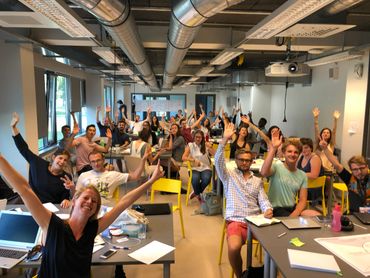
I design collaborative innovation environments that enable teams to explore opportunities, synthesize insights, and make progress through evidence-based entrepreneurship. My work encompasses venture-building programs, startup incubation, and corporate innovation initiatives, utilizing human-centered design principles across the MENA region and beyond.











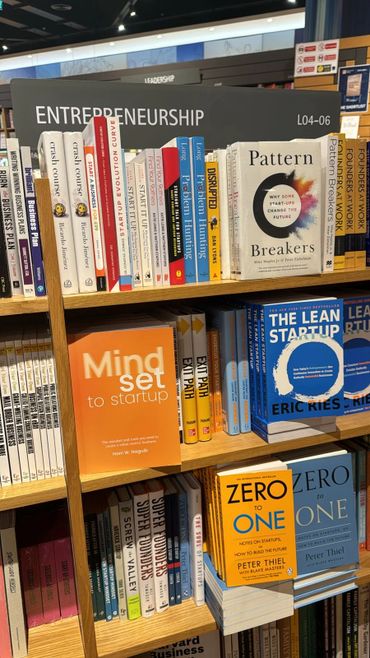
My book, Mindset to Startup, was published internationally by BIS Publishers in 2024.
The book explores entrepreneurship not only as a business activity, but as a human process shaped by perception, experimentation, learning, and value creation.

.jpeg/:/rs=w:370,cg:true,m)


Cairo, Egypt